This review of Will McIntosh’s first novel Soft Apocalypse originally appeared on Tor.com. Will’s second novel is due out later this month, so I thought I’d revisit his debut. My review of Will’s sophomore effort Hitchers will follow in a few days.
Jasper and his tribe of formerly middle class Americans describe themselves as nomadic rather than homeless: they travel around the Southeastern U.S., scraping together the bare minimum to survive by spreading out solar blankets or placing small windmills by the highway to collect energy from passing cars, then trading the 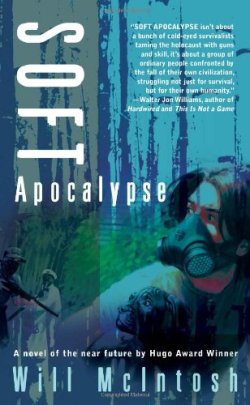 filled fuel cells for food. Fewer and fewer people want to deal with the “gypsies” who use up dwindling resources, and often they meet with indifference or even violence. Jasper was a sociology major, but those skills are no longer in demand in 2023, about ten years after an economic depression set off the Great Decline and society as we know it gradually began to fall apart. So begins Will McIntosh’s excellent debut novel, Soft Apocalypse.
One of the most interesting aspects of Soft Apocalypse, and something I’ve rarely seen done so well in a dystopian novel, is the fact that it shows society in the early stages of dissolution. Many post-apocalyptic stories show a finished end product, an established dystopia in which the Earth has already been torn apart and people are trying to survive the aftermath. Other stories show the events right before and during the actual earthquake/meteor strike/plague, with people trying to make it through the disaster as it happens. Soft Apocalypse instead happens during a period of gradual but inexorable decline: as the back cover says, the world ends “with a whimper instead of a bang.” If Robert Charles Wilson’s excellent Julian Comstock: A Story of 22nd America is set in post-collapse U.S.A., when enough time has passed for society to fall back into established structures and classes, Soft Apocalypse could almost be set in the same world, but a couple of centuries earlier and during the gradual collapse of the previous system.
Continue reading →
 Here’s my review of Stormed Fortress, a great novel by one of my favorite fantasy authors, Janny Wurts. I’ve reviewed the entire Wars of Light and Shadow series in the past, but I am reposting this review here because it’s a ridiculously under-appreciated series that should have a much larger readership than it currently has.




 Far Beyond Reality